EXPERTISE
Integration failures can have devastating consequences for businesses. When integrations unexpectedly stop working, they can lead to:
- Corrupted datasets
- Unnecessary costs
- Lost potential revenue
- Customer service disasters that damage reputations and relationships
The impact of integration problems on businesses is significant and far-reaching. Integration challenges often arise not from a single issue but from a combination of factors. However, by identifying the causes of integration failures, businesses can implement controls and contingency measures to reduce their likelihood and mitigate software integration problems.
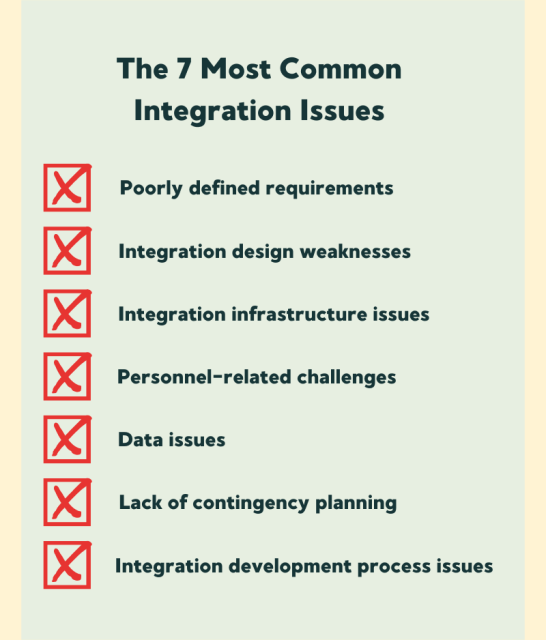
Key Causes of Integration Issues
- Poorly Defined Requirements: Clear and comprehensive requirements are essential for successful integration. Overlooked or poorly defined requirements include: • Knowledge of target systems • Data quality and volume expectations • End-to-end security measures • Operating parameters • Error-handling processes
- Integration Design Weaknesses: Design flaws, often influenced by personal biases or tool limitations, can lead to ineffective integration solutions. Common integration challenges include choosing the wrong approach, facing technical constraints, insufficient documentation, and using inefficient architectures.
- Integration Infrastructure Issues: Success depends on the chosen technology stack. Common software integration problems include unstable middleware, architectural flaws, and inadequate monitoring systems.
- Personnel-Related Challenges: The success of integration projects depends on skilled personnel. Integration issues often arise from limited availability of skilled staff, budget constraints, lack of continuity, and insufficient technical competence of personnel.
- Data Issues: Data quality and management are critical. Common data-related integration problems include incomplete or erroneous data, unexpected data volumes, and duplicated data.
- Lack of Contingency Planning: Preparing for potential integration failures is crucial. Effective contingency planning involves defining restoration processes, implementing system synchronization, and regular testing of recovery procedures.
- Integration Development Process Issues: Integration errors may arise during the development phase due to insufficient testing, lack of governance, and unvalidated assumptions.
Common Integration Failure No. 1 – Poorly Defined Requirements
Integration projects can vary in type, approach, and complexity, with each option having its own advantages and disadvantages. To ensure a successful integration, businesses must clearly and comprehensively define their requirements. Failure to do so may result in solutions that don’t meet stakeholder expectations or address all possible scenarios and risks.
Frequently overlooked or poorly defined requirements include:
- Knowledge of target systems and their related processes
- Data quality, volume, and transaction speed
- End-to-end security requirements
- Operating parameters (such as throughput, transaction time, etc.)
- Error and exception handling processes
- Data contention and record-locking / change roll-back policies
To avoid system integration issues, it is crucial to conduct a thorough and detailed analysis of the integration scope before starting the project. Investing time in scoping, requirements analysis, and assumption testing will pay dividends in the long run and help mitigate integration challenges.
Common Integration Failure No. 2 – Integration Design Weaknesses
Integration designs can be influenced by personal biases, skills, or tool limitations, potentially resulting in poor integration solutions with hidden flaws that only surface when tested in real-world conditions.
Common integration design issues include:
- Choosing the wrong approach or methodology for the situation
- Facing technical constraints or challenges with platforms or tools
- Lacking sufficient documentation, leading to wrong assumptions or decisions
- Selecting an architecture that can’t handle expected workload or adapt to sudden changes in demand
- Using APIs that don’t cover all integration cases or needs
- Deploying inefficient solutions that hinder scaling
Most of these problems can be avoided with better design. The selection of methodology and tools should be based on a wide range of factors and leverage the team’s collective experience in different integration scenarios. This approach can significantly reduce the risk of integration failures and software integration problems.
Common Integration Failure No. 3 – Integration Infrastructure Issues
The success of an integration heavily depends on the technology stack used to implement it. Each component must be suitable for the integration’s goals and challenges. Different platforms have different capabilities and limitations, making it vital to understand how and when to use available tools and options for each integration scenario.
Common integration infrastructure issues include:
- Unstable or unavailable middleware platforms
- Architectural flaws creating bottlenecks or single points of failure
- Lack of support for various transfer methods, protocols, or standards
- Inadequate monitoring of integration infrastructure
- Suboptimal configuration choices
- Wasteful resource consumption or unnecessary processing overhead
Even the best technology can fail if misused or applied to the wrong purpose. Regular monitoring and reconfiguration are necessary to keep integrations stable, secure, and efficient, thus minimizing integration errors and software integration problems.
Common Integration Failure No. 4 – Personnel-Related Challenges
People are at the heart of all integration projects, and the success or failure of any project depends on the resources allocated to it. It’s important to recognize the impact that poor staffing decisions can have on a program of work. The difference in contribution between good and average developers is significant, with great developers being rare. Securing the best mix of resources within commercial constraints is key to success.
Common personnel-related integration challenges include:
- Limited availability of suitably skilled personnel
- Budget constraints making experts unaffordable
- Lack of resource continuity throughout the project
- Insufficient technical competence of assigned personnel
- Self-imposed constraints due to personal experiences and skills
- Demotivating exceptional talent with mundane tasks
To achieve success, leverage a variety of skillsets with varying levels of experience throughout the project lifecycle. Accessing the collective knowledge pool and skills of a team of integration specialists helps ensure your project delivers and mitigates system integration failures.
Common Integration Failure No. 5 – Data Issues
Data is the cornerstone of every integration. However, many people overlook the importance of assessing and analyzing the datasets they work with. It is incredibly dangerous to assume that the data being passed is 100% accurate.
To avoid integration errors, integrations should proactively evaluate the data they are accessing or transferring and align with the master data management policies of the business.
Data-related issues that may impact integration performance include:
- Incomplete or erroneous data
- Higher than anticipated data volume or update frequency
- Data not provided by the defined input parameters
- Exception volume exceeding design assumptions
- Duplicated data causing reconciliation issues
- Lack of awareness of behind-the-scenes referential integrity requirements
Data integrity matters. Being able to demonstrate the provenance and chain of custody for data can be crucial. Essential aspects of data management in integrations include:
- Safeguarding privacy
- Protecting sensitive information
- Ensuring data sovereignty is maintained
- Demonstrating regulatory compliance
Addressing these data issues is critical to preventing integration failures and ensuring smooth system integration. By prioritizing data quality and management, businesses can significantly reduce the risk of integration problems and improve the overall performance of their integrated systems.

Common Integration Failure No. 6 – Lack of Contingency Planning
Integration projects are not immune to failures. The impact of a failure on the business depends on how well the integration was designed to handle service restoration and data integrity issues.
It is wise to be prepared for the worst. No matter how robust the integration infrastructure is, incidents can occur. Planning helps ensure data quality and reduce system recovery time.
Factors that can mitigate the damage of an integration failure include:
- Defining the integration restoration process
- Synchronizing the system after a failure
- Queuing or batching transactions
- Defining data integrity checkpoints or snapshots
- Implementing roll-back capability
- Regularly testing recovery processes
To deliver value consistently, an integration project needs to be maintained and monitored. Procedures for service reinstatement should be defined and tested frequently to ensure the reliability of the whole solution. This approach helps address integration challenges and reduces the risk of system integration failures.
Common Integration Failure No. 7 – Integration Development Process Issues
Systemic integration issues that don’t originate during the requirements capture or design phases are often inadvertently introduced during the development of the integration itself. Standard project governance processes and rigorously assuring control effectiveness help mitigate the risk.
Common reasons why the delivered integration fails may include:
- Insufficient testing
- Inadequate integration hardening, making it susceptible to exception-based issues
- Lack of governance/project assurance to ensure necessary tasks are completed
- Unvalidated or unproven assumptions
- Last-minute design changes, scope creep, and arbitrary delivery dates
- Lack of telemetry incorporated into the delivered solution to enable monitoring of integration health
Building an integration is similar to constructing anything else. It requires the consistent and focused application of project management controls to ensure that what is delivered is fit for purpose. By addressing these integration development process issues, businesses can significantly reduce the likelihood of software integration problems and improve the overall success rate of their integration projec
Conclusion – The Impact of Integration Issues on Business Growth
Integration issues can significantly hinder business processes and growth. By understanding and addressing the common causes of integration failures, businesses can mitigate risks and ensure successful integration projects.
Integrations are crucial for many business processes and operations. However, many Systems Integrators do not allocate sufficient attention or resources to integration projects. This oversight can lead to costly and damaging integration failures. The connections between systems enable the process. If those connections break, the process breaks too, sometimes with disastrous consequences.
To avoid integration problems, it is important to be aware of the common causes and risks of integration failures. When planning your integrations, we suggest using the list above to evaluate proposals and project plans, ensuring that major risks are addressed. This proactive approach can help you overcome system integration challenges and minimize software integration problems.
How to Prevent Integration Failures? Key takeaways:
- Recognize the critical role of integrations in business operations
- Allocate adequate resources and attention to integration projects
- Understand and address common causes of integration failures
- Use the provided list to evaluate and mitigate integration risks
- Implement robust contingency plans for potential integration issues
How Multishoring Prevents Integration Project Failures?
At Multishoring, integration processes are our expertise. We tackle common integration challenges by reducing risks and avoiding mistakes to deliver successful projects.
Our approach focuses on essential aspects, ensuring integrations are stable, secure, and scalable. We tailor projects to your risk tolerance, budget, and timeline, avoiding overcomplication and ensuring quality.
We will work with you to define the best schedule of work based on your risk tolerance, budget, and timeline. We want you to be confident in the solution and its performance. We do not overcomplicate projects or cut corners that could compromise the quality of the integration.
Integrations can be complex, but they do not have to be complicated. We use our experience and expertise to handle challenging integration scenarios and make them happen. We do what is necessary to make your integrations stable, secure, and scalable so that you can focus on other things.
Avoid software & system integration challenges with our services


Other articles


Case studies

A Partnership That Matures Like Fine Wine: A Case Study of IT Integration for Pernod Ricard
Pernod Ricard partnered with Multishoring in 2012 to develop a global document exchange solution using BizTalk, leading to a 10-year collaboration that improved integration processes across all branches.
Let's talk about your IT needs

Let me be your single point of contact and lead you through the cooperation process.


Signed, sealed, delivered!
Await our messenger pigeon with possible dates for the meet-up.